
| |
| |
| |
| |
| |

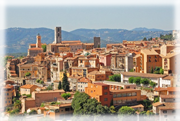
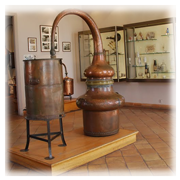
The presence in Grasse of wealthy merchants and numerous craftsmen particulary tanners, as far back as the Middle-Ages, made this town an important trading centre in Europe. The fashion for scented leather, particularly gloves, and the cultivation of aromatic plants providing fragrant raw materials gave great impetus to the Grasse perfume industry as early as the 16th Century. Under the Second Empire, Grasse became aan important industrial centre specialising in perfumes, thus bringing prosperity to the center with its concentration of powerful industrial companies involved in the production of essential oils. Distillation Steam distillation is one of the oldest extraction processes, developed by the Arabs. The object is to allow the steam flow to trap the raw material volatile constituents. The steam, saturated with essential oil, is then condensed in a water-cooled coil or serpentine and the mixture flows into an "essencier" or essential oil decanter. The oil separates gradually and settles on the water surface because of its different specific gravity. "Enfleurage" Long ago, the ancients had noticed the propensity of oils and fats to absorb odours. It was not until the 19th century, however, that the "basic fragrance" of raw materials absorbed by fats could be extracted using ethyl alcohol. In this old process fresh delicate flowers like jasmin, tuberose or violet are placed on glass frames previously coated with a layer of a blend of beef and pork fat. According to the species, the flowers are replaced by fresh ones every 3,5 or 7 days over a period of 60 days. These fats, saturated with fragrance, are stirred vigorously and washed in ethyl alcohol in a "batteuse", a kind of churn, to produce scented pomades. These pomades are used for cosmetics or drained of their fragrance by ethyl alcohol in order to be used in perfumes. Extraction In this process, the raw material is steeped in a volatile solvent in an extractor. After a series of washings, the solvent loaded with the flagrant matter flows into a "concentrator", to be partially distilled and a "batteuse" (a kind of churn) with an amount of ethyl alcohol and after filtration, the liquid is chilled to precipitate any traces of plant wax non-miscible with alcohol. The pure oil or "absolute" is obtained after a final concentration process. Fractional Distillation Fractional distillation or "fractionalisation" allows the isolation of chemical constituents from essential oils. Essential oils can thus be improved. Furthermore, certain "fractionated" essential oils give off a different fragrance from the original ones. From eugenol isolated from clove oil for instance, one can obtain iso-eugenol, reminiscent of the fragrance of carnations. The Perfumer The perfumer is an artist with a highly developed sense of smell. From the very beginning and all throughout his career, the perfumer constantly widens his "repertoire" of odours. Seated at his perfume organ lay-out, like a musician, he composes fragrant harmonies with the aid of smelling blotters or smelling strips. The success of a perfume depends on the creative ability of the perfumer, whose genius is revealed in the way he selects and blends flagrant materials.
|
|
Find us on |
 |
With Parfums de France, rest assured that all transactions are secured and door to door delivery is guaranteed
|
|
||
All our products at Parfums de France are generically packaged under our own brand. All packaging images displayed on our website are meant for reference use only. |
|||
Our Hotline +27 72 205 9147 or +27 11 024 7659 | Terms & Conditions | Privacy Policy |
|||
© 2011 - 2013, Grasse Perfume Importers cc, all rights reserved |
 |
||
